
Commercial and Industrial Property - Leasing and Sales
whatsapp 0788794975
whatsapp 0788794975

The Western Cape is the only province in South Africa that has managed to record a real increase in the average repeat sales value of residential properties, according to the latest house price inflation indices published by Lightstone Property.
As at end of March, the annualised Lightstone Property Inflation Index for the Western Cape stood at 5.8%, compared to the Consumer Price Index (CPI) of 4.5%. After adjustment for the CPI, all of the other eight provinces recorded negative house price trends.
In the week of the country’s sixth round of democratic elections, it is useful to consider some of the reasons why the Western Cape continues to represent a beacon of hope in an otherwise troubled national socio-political and economic environment.
First and foremost, 12 of the 20 best-run municipalities in the country are in the Western Cape, with Mossel Bay and Swartland in positions number one and three respectively. Not a single municipality in the group of the 20 worst-managed is in the Western Cape.
Dysfunctional local authorities
The latter list of largely dysfunctional local authorities is dominated by regions in KwaZulu-Natal and the Eastern Cape, with no fewer than 16 of them controlled by the ANC. In sharp contrast, 15 of the best performing local authorities are led by the DA (alone or in coalition).
The ranking of South Africa’s municipalities is conducted annually by Good Governance Africa. The research and analysis uses data from Statistics SA, auditor-general reports, municipal information and National Treasury.
It covers three areas:
The quality of administration
Economic development
Service delivery
Research by Municipal IQ mirrors the results of the rankings by Good Governance Africa. In its latest study of the most productive municipalities, which emphasises development and not merely maintenance, Municipal IQ found that eight of the 10 municipalities that scored the highest for productivity indicators are in the Western Cape.
It is fairly obvious that the Western Cape provincial government has a superior track record with regard to virtually every aspect of governance, including the maintenance and improvement of infrastructure. The latter includes transport, health and education.
A cursory analysis of the value of building plans passed by the larger municipalities in South Africa confirms an upward trend in residential construction activity in the Western Cape, which closed the gap on Gauteng during 2018.
Now that the Western Cape has been blessed with fairly good winter rains, the phenomenon known as ‘semigration’ is returning.
There is higher demand for residential properties in this province than in the rest of the country.
Job creation
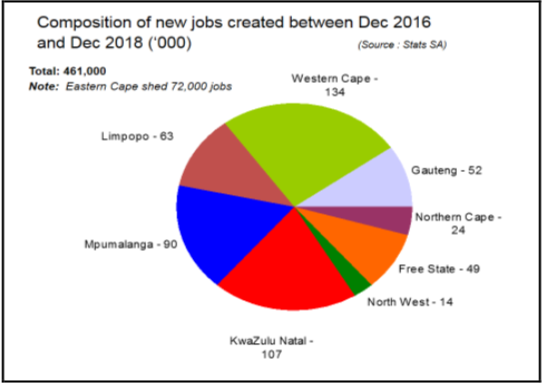
Furthermore, the Western Cape has managed to create more jobs since the end of the global recession in 2009 than seven of the other eight provinces. Only Gauteng has managed to create more jobs, which is fairly predictable, given its demographic advantage, highly diversified economy and proximity to markets in sub-Saharan Africa.
Source: Stats SA
However, when viewed over the last two years, during which the economy was under severe pressure, the Western Cape outperformed all the other provinces, creating 29% of new employment opportunities in the country.
One of the most prominent socio-economic features of the Western Cape, which also serves as one of the explanations for its regional ranking for a host of indicators, is the fact that it has the highest percentage of households in the R120 000 per annum plus income category.
According to the latest annual Household Survey, published by Statistics SA, more than a third of the Western Cape’s households spend R120 000 or more per annum (due to the fact that South Africa’s individual household savings propensity is close to zero, this figure equates to income).
Nationally, the average proportion of households in this category is half of the figure for the Western Cape, namely 16.9%. Gauteng is in second place at 23.3% and Limpopo is at the bottom of the pile with a mere 5.5%.
The Western Cape government should consider lobbying for a strengthening of federalism in South Africa, particularly with regard to increased taxation powers for the provinces – preferably linked to a more robust system of quantifiable performance indicators and accountability.
The province is clearly a cut above the rest and deserves fiscal recognition for good governance and infrastructure maintenance.